
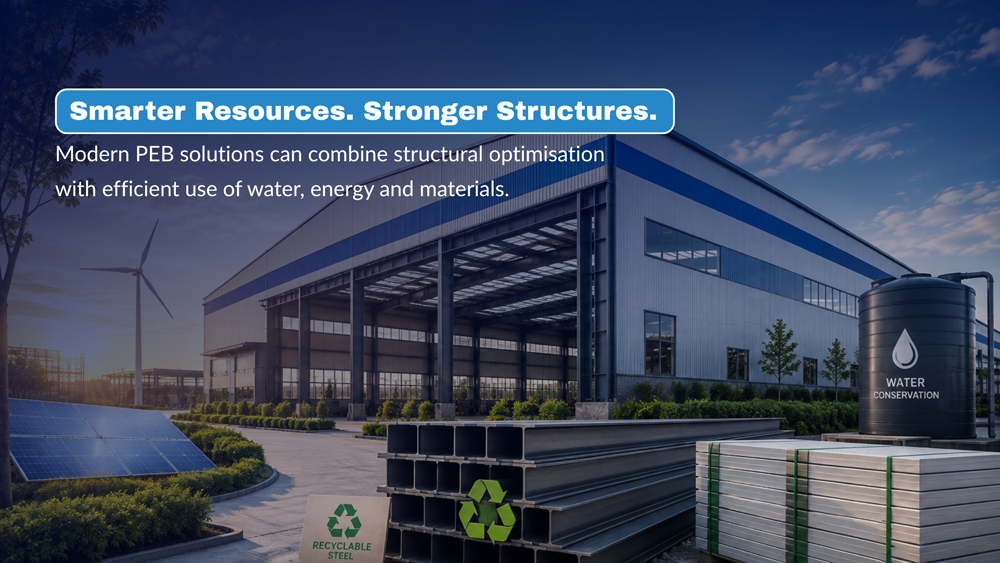
Sustainability is becoming an increasingly important consideration in industrial construction. From reducing resource consumption to improving operational efficiency, modern buildings are expected to deliver more while using fewer resources. Water, energy and material efficiency in PEB projects can play an important role in creating industrial structures that are both practical and environmentally responsible.
Pre-Engineered Buildings (PEBs) offer a significant advantage through engineered design, optimised material usage and efficient construction processes. These characteristics make PEBs well suited to the evolving requirements of sustainable industrial development.
Improving Material Efficiency Through PEB Design
Material optimisation is one of the fundamental advantages of a PEB system. Unlike conventional construction, structural components can be designed and manufactured according to specific project requirements.
Optimised Structural Components
Engineered columns, rafters, purlins and other components can be optimised based on actual structural requirements. This helps minimise unnecessary steel consumption while maintaining the required strength, stability and performance.
Precision manufacturing can also help reduce material wastage during fabrication and installation.
Enhancing Energy Efficiency in Industrial Buildings
Energy efficiency extends beyond the building structure itself. The design of an industrial facility can influence natural lighting, ventilation, thermal performance and overall energy consumption.
Designing for Natural Light and Ventilation
Features such as skylights, appropriate building orientation, ventilation systems and insulation can help improve indoor conditions while reducing dependence on artificial lighting and mechanical cooling.
Proper roof and wall insulation can further contribute to improved thermal performance, particularly in industrial facilities exposed to varying climatic conditions.
Managing Water Resources More Efficiently
Water efficiency is another important consideration for sustainable industrial development. While water requirements vary by facility, building planning can incorporate systems that support responsible water management.
Integrating Water-Efficient Solutions
Modern industrial projects can consider rainwater harvesting, efficient drainage systems and water reuse strategies where appropriate. Coordinating these systems during the initial design stage can improve overall site efficiency and reduce avoidable resource consumption.
Building More Efficiently for Long-Term Performance
The benefits of resource-efficient design extend beyond construction. A well-engineered sustainable PEB project can contribute to lower operational requirements, reduced wastage and improved long-term building performance.
Key benefits include:
- Optimised material consumption
- Improved energy efficiency
- Better utilisation of natural resources
- Reduced construction wastage
- Improved thermal performance
- Potentially lower operational costs
- Greater focus on sustainable industrial development
By considering water, energy and materials together, developers can create industrial buildings that balance performance, efficiency and sustainability.
Engineering a More Efficient Industrial Future
Sustainability in industrial construction is not limited to a single technology or material. It is about making better decisions at every stage—from structural design and material selection to construction and long-term operation.
Adoriva Infratech delivers engineered PEB solutions for modern industrial requirements, with a focus on structural optimisation, functional design and efficient construction. By integrating engineering expertise with project-specific requirements, modern PEBs can help industries move towards more resource-conscious infrastructure.
📧 Email: sales@adorivainfra.co.in
📞 Call: +91 7666964553